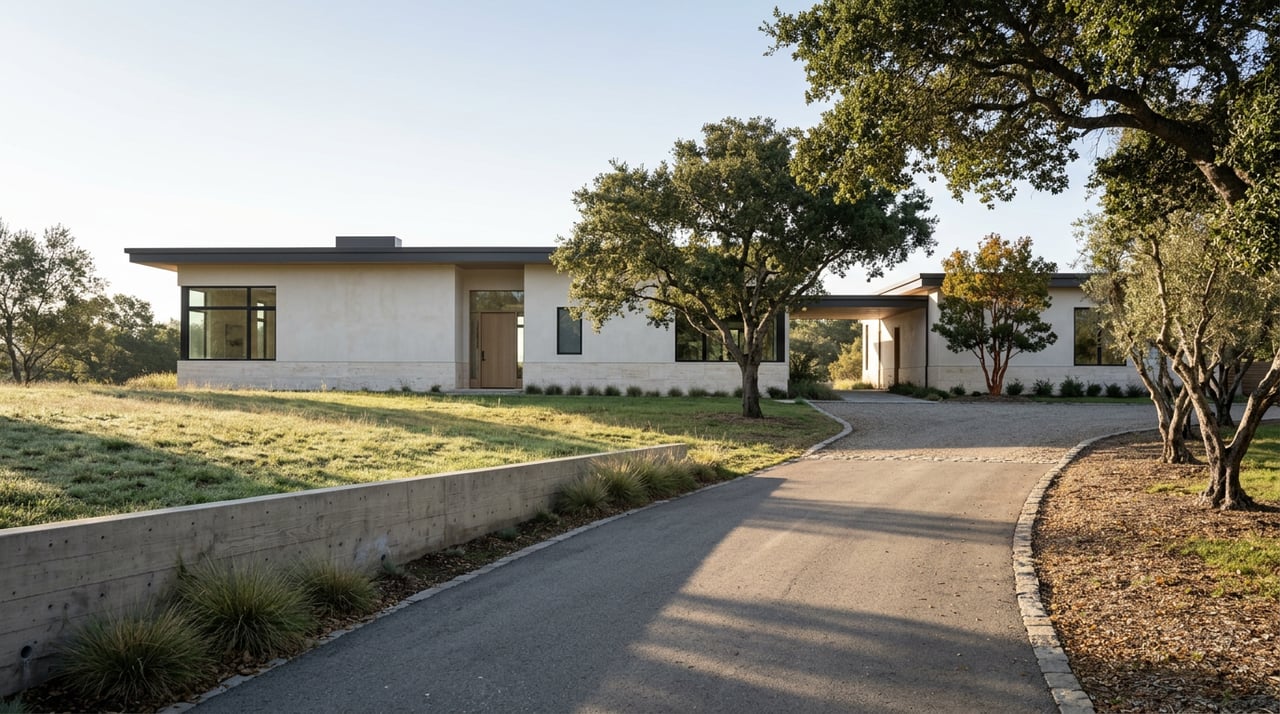
Drive through Los Altos Hills on a Saturday morning and you will not pass a coffee shop window with a line out the door, a hardware store with sidewalk sale bins, or a corner where three restaurants compete for lunch traffic. The town's one-acre zoning minimum keeps houses spread across ridgelines and creek bottoms, which means there is no commercial strip to anchor a weekend. For a long time that has been shorthand for "nothing happens here."
It is also wrong, and the wrongness has gotten easier to see this year. The town does not lack a center. It has three addresses that serve as civic hubs, none of them stores. Together, they carry more of the town's actual social calendar than most residents realize until they start counting.
A Center Built Around Public Places, Not Storefronts
The pattern shows up the moment you map where things actually happen. Westwind Community Barn sits at 27210 Altamont Road, next to the Byrne Preserve entrance. A few minutes away on El Monte Road, Foothill College's Smithwick Theatre runs a full performance calendar. Back near Town Hall on Fremont Road, the newly remodeled Heritage House just reopened. None of these exist because a developer saw foot traffic potential. They exist because residents gave the town land, or because a community college happened to be built here, or because a 1908 farmhouse needed somewhere to go when it was moved out of downtown Los Altos in 1985.
That is the mechanism worth naming. In a town built to keep commerce out, civic life didn't disappear. It gathered around public places, and it runs on a calendar most residents only see one piece of at a time.
| Site | Address | What It Anchors |
|---|---|---|
| Westwind Community Barn | 27210 Altamont Road | Horse shows, town-run community events, the entrance to Byrne Preserve |
| Byrne Preserve | Adjacent to Westwind Barn | The town's most-used hiking loop |
| Heritage House | 26379 Fremont Road, next to Town Hall | Local history, just reopened after a remodel |
| Smithwick Theatre, Foothill College | 12345 El Monte Road | Concerts, dance, and theater |
The Barn Sets the Social Calendar
Westwind Barn is where the town's calendar actually lives. It hosted a Hoedown on September 5, with a live band, food trucks, a dance caller, and a horse show, the kind of afternoon that doesn't show up on a real estate flyer but does show up on nearly everyone's calendar who has kids or horses or both. Beyond that one afternoon, the barn hosts a rhythm most residents underestimate: the town runs about five community events there each year, and Victoria Dye Equestrian, the program that operates lessons and camps out of the facility, adds two more horse shows on top of that. Add it up and the barn is doing the job of a town square roughly once every seven or eight weeks, just without a square attached to it.
The Preserve Next Door Sets the Physical One
Walk out the back of the barn and you're already inside Byrne Preserve, which is where the town's other calendar, the one built around trails rather than events, actually starts. The preserve exists because Albert M. Byrne donated land to the Nature Conservancy and Countess Betty Byrne Dezahara added more; the town later folded those gifts together with smaller parcels into the roughly 55-acre preserve that's there today. The main loop, the Artemas Ginzton Path, runs 3.1 miles with about 505 feet of elevation gain and ends at a hilltop oak with a sightline that runs from Stanford to NASA Ames to the Bay. The path's namesake, Artemas Ginzton, was a Varian executive and one of the people locally credited with pushing for the town's pathway system in the first place, which means the most popular trail in town is named for someone who spent his own time trying to connect it to everything else.
That connection is not abstract. The town's Pathways Run/Walk, now in its 24th year, starts at Westwind Barn and routes directly through Byrne Preserve before extending into the wider pathway network. This year's race ran on May 9, a hilly 5K and 10K plus a one-mile fun run that turns the barn-to-preserve corridor into the closest thing the town has to a parade route.
History Reopens Beside Town Hall
The newest piece of this cluster is also its oldest building. As Los Altos Online reported, Heritage House was built in 1908 by the Eschenbruecher family on Second Street in downtown Los Altos. In 1944, a stray shell from a training exercise at the nearby Page Mill Army Camp put a hole in the roof and damaged plaster in several rooms, a detail that tends to surprise people who assume nothing dramatic ever happened to a farmhouse. The house was designated a historical landmark and relocated to its current spot next to Town Hall in 1985, and it sat largely unchanged until this year's remodel updated its systems while keeping its character intact.
The town marked the completion with a ribbon-cutting on August 19, timed deliberately to coincide with the town's 70th anniversary, which puts its incorporation at 1956. Los Altos Hills History Committee Co-Chair Bernardo Ferrari brought a selection of his grandfather's century-old photographs to share at the opening. In its report, Los Altos Online quoted Mayor Rajiv Bhateja as saying:
"This is a tribute to how much we value history and tradition in our town."
The remodel was partly funded through a Community Development Block Grant from the state, funneled through the County of Santa Clara's Office of Supportive Housing and Community Development, which is its own small reminder that even a town this affluent leans on the same public funding mechanisms as everywhere else when it wants to preserve something.
The One Real Night Out
The fourth piece sits just down El Monte Road. Foothill College's Smithwick Theatre seats roughly 950 people and functions as the closest thing Los Altos Hills has to a night out that doesn't involve driving to Palo Alto or Mountain View. Its calendar runs wider than a typical college auditorium, covering everything from Hindustani classical concerts to the college's own theater and dance productions, which means the same building that hosts a campus play one month might host a touring musician from another continent the next.
None of these four places were built to work together. A community college board, a pair of land donors, a town council chasing a historic preservation grant, and a nonprofit horse program all made separate decisions decades apart. What they ended up building, without coordinating, is a version of a town center that runs on public places and public calendars instead of leases and storefronts. It is slower to notice than a Main Street, because there's no single block to walk down and see it all. But residents who have lived here for years are often the ones most surprised to learn that the trail they run on connects, by name and by geography, to the barn where their kids saw a horse show, which sits a five-minute drive from the theater where they saw a concert last spring, all radiating from a stretch of road most of the Peninsula drives past without a second look.
For a deeper look at what makes Los Altos Hills estates distinct once you get past the trails and into the properties themselves, our guide to what luxury buyers prioritize in Los Altos Hills estates covers the ground this piece doesn't. And if you want the fuller picture of the town, from its open space to its housing character, our Los Altos Hills neighborhood guide is the place to start.
If you're weighing a move within Los Altos Hills, or curious what your own property might be worth against a market this particular, Maria Afzal offers a complimentary luxury marketing consultation for anyone ready to talk specifics.
This article is general information, not legal, tax or financial advice. Consult a qualified professional about your situation.